Why choose us?
1. Oldest Department in Pakistan's History
The Department of Civil Engineering is the oldest engineering department of Pakistan, which has actively contributed to transforming academia and developing an educational infrastructure since 1922. At the undergraduate level, it offers a competitive four-year degree programme based on a comprehensive curriculum. In 1979, the department started its Postgraduate programme leading to a masters in civil engineering by coursework, and at the verge of a new millennium, incepted the Master of Engineering by research. The Department of Civil Engineering provides professional experience and has emerged as a dynamic, continuously evolving academic feature, providing its people with a competitive edge over other institutions.
The Department has adopted Outcome-Based Education (OBE) and Outcome-Based Assessment (OBA) for its Bachelor of Engineering (Civil), as recommended by the Engineering Accreditation Board (EAB) of the Pakistan Engineering Council. The department and its people believe in establishing an environment conducive to continual improvement by maintaining the quality of education and ensuring that the knowledge is imparted effectively, irrespective of teaching programmes conducted at undergraduate or postgraduate levels.
The Department strives to excel in teaching, research, and innovation in civil engineering and associated fields to produce professional engineers and leaders contributing towards purposeful and sustainable development at the national and global levels.
2. OBE Accredited Programme & Pioneers of Outcome-Based Eduction System in Pakistan
The Civil Engineering and Specialisation in Construction Engineering Programmes are based on outcome-based education (OBE), which is a standard for international accreditation. OBE is an educational approach where the curriculum, institution, and assessment are driven by the desired learning outcomes that graduates should be able to achieve upon completing the programme.
The university follows the instructional Programmes in the English language and examinations based on the Semester System. The Department of Civil Engineering has adopted an Outcome-Based Education (OBE) and Outcome-Based Assessment (OBA) for its Bachelor of Engineering in Civil Engineering as recommended by the Engineering Accreditation Board (EAB) of the Pakistan Engineering Council.
3. Washington Accord Recognised Degree
The degree of Civil Engineering and Specialisation in Construction Engineering is recognised by the Washington Accord. A Washington Accord-recognised degree provides graduates with enhanced career mobility by enabling their qualifications to be recognised in other signatory countries. It assures quality education that meets global standards, which improves employment opportunities and facilitates the pursuit of postgraduate studies abroad.

4. Great Learning Experience
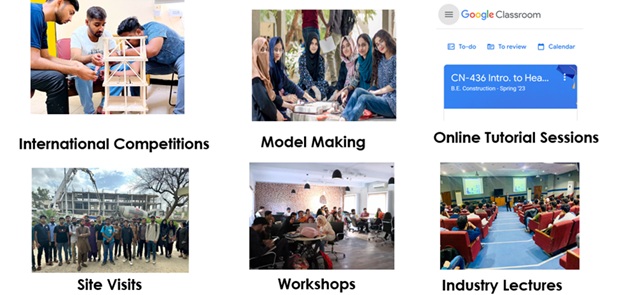
The Department of Civil Engineering offers a wide range of learning opportunities available to students beyond the classroom and different hands-on or real-world experiences that support stronger academic and professional growth. Students take part in local and global contests where they test their skills, solve real problems, and learn teamwork under pressure. Teamwork is another experience that the department provides in various ways, such as groups of students building physical models, helping them understand design, structure, and practical problem-solving.
The department firmly believes in online tutorial sessions and the use of digital learning platforms, such as Google Classroom, which allow students to review lessons, join discussions, and get support anytime other than the classroom. Students also visit real project locations to observe how classroom concepts are applied in the field.
Apart from all, interactive sessions in the form of workshops are organised regularly where students learn new tools, techniques, or ideas directly from experts. Other than this, Industry lectures delivered by professionals from the various domains of the Civil Engineering field share insights about current trends, challenges, and career paths, giving students a clearer sense of the industry.
Overall, the Department of Civil Engineering provides a great learning environment that blends theory with practice, helping students gain confidence, creativity, and real-world readiness.
5. Advanced Computational and Testing Facilities
The Department of Civil Engineering affirms that Advanced testing and computational facilities play a key role in modern education, research, and industry. They give students and professionals the tools to explore ideas with accuracy, solve problems faster, and create better outcomes.
There are several advanced testing labs in the department, which allow students to study how materials, systems, or structures behave under real conditions. Instead of relying only on theory, students can verify results through experiments. This builds confidence, sharpens judgment, and teaches them how to analyse data with a critical eye. Second, computational facilities let users run complex simulations that would be difficult or impossible to perform by hand. With high-powered software, they can model structures, predict performance, test design options, and compare solutions quickly. This reduces trial and error and encourages smarter decision-making.
Together, these facilities close the gap between classroom learning and real-world engineering. They help students build practical skills, encourage innovation, and support high-quality research. In a fast-moving world, having access to such resources is not a luxury. It is essential to produce graduates who can compete, adapt, and lead.
